This guide explains everything you need to know about all on 4 dental implants union county il and covers candidacy, procedure steps, recovery, costs, and local options. If you’re considering full-arch teeth replacement, this page will help you understand who is a good candidate, what to expect at each step, common risks and benefits, and how we coordinate care with your restorative dentist. Practical next steps are included so you can schedule a careful, no-rush review of your case.
What Are All on 4 Dental Implants?
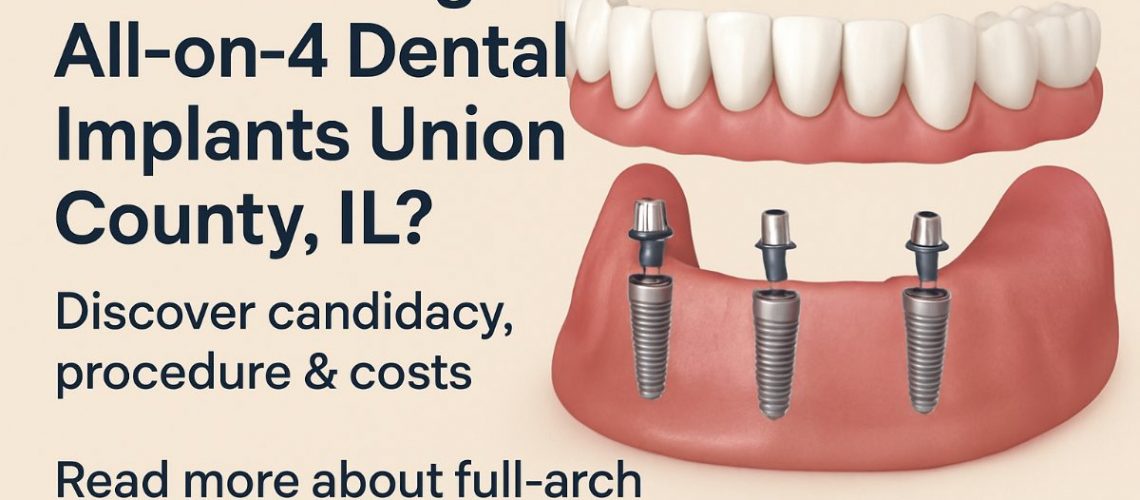
All on 4 dental implants use four strategically placed endosteal implants to support a full-arch prosthesis. Instead of placing an implant for each missing tooth, the all on 4 method attaches a fixed bridge to those four implants, giving strong chewing ability and a natural look. This differs from single-tooth implants because it replaces an entire arch with fewer implants and often avoids complex bone grafting.
Who Is A Good Candidate for All on 4 Dental Implants?
Health and oral requirements
Good candidates are generally healthy adults with failing or missing teeth who want a fixed full-arch solution. Key factors we review:
- Medical conditions: uncontrolled diabetes or severe heart disease can increase risks.
- Smoking: increases risk of implant failure and slower healing; we counsel patients on quitting or reducing use.
- Oral health: active gum disease must be treated first.
- Bone volume: all on 4 often uses available jaw bone, but severe loss can change the plan.
When zygomatic implants are considered
If the upper jaw has severe bone loss, zygomatic implants (anchored in the cheekbone) may be recommended. We do not use mini or subperiosteal implants; only endosteal and zygomatic implant types are considered for full-arch treatment when clinically appropriate.
Typical Treatment Steps for All on 4 Dental Implants
Initial consult and imaging
Your initial visit includes a thorough medical and dental review and Cone Beam CT (CBCT) imaging. We do not perform same-day consult-to-surgery. The extra time lets us study your scans, plan implant positions, and discuss realistic outcomes before any surgery.
Planning and prosthesis coordination
We use digital scans and the IS 3800W intraoral scanner to design the prosthesis. We coordinate closely with your general dentist or restorative dentist so the final teeth meet esthetic and functional goals. Communication between surgical and restorative teams improves long-term results.
Surgery day: extractions and implant placement
When clinically appropriate, we often perform tooth extractions and place implants on the same day. You’ll receive a temporary fixed arch while implants begin integrating with bone. Final prosthesis placement happens after adequate healing and testing of implant stability.
What To Expect During Healing And Recovery
Soft tissue healing usually takes 2–4 weeks. Osseointegration (bone bonding to implants) takes several months—commonly 3–6 months depending on the site and bone quality. Expect multiple follow-up visits to monitor healing, check implant stability with Osstell ISQ, and finalize the prosthesis when the team agrees stability is sufficient.
Benefits and Risks of All on 4 Dental Implants
Common advantages:
- Stable chewing and improved nutrition
- Preserves jaw bone better than removable dentures
- Shorter overall treatment time versus multiple individual implants
Potential risks include infection, implant failure, prosthesis complications, and the need for additional surgery if bone issues arise. Smoking, uncontrolled medical conditions, or poor oral hygiene raise complication risks.
Cost Factors and Financing Options for All on 4 Dental Implants in Union County, IL
Costs vary based on implant number, whether PRF or bone grafting is required, use of advanced imaging, lab fees for the prosthesis, and surgeon experience. Many patients use medical credit plans, CareCredit, or in-office financing to make treatment manageable. We review costs clearly during the planning visit.
How We Plan For Safety and Predictable Outcomes
We emphasize careful case review and do not rush from consult to surgery. Planning uses CBCT scans and the IS 3800W intraoral scanner. When useful, we employ Platelet-Rich Fibrin (PRF) and PIEZOSURGERY® to improve healing and reduce trauma. Most cases allow same-day extraction into implant placement when clinically appropriate.
Advanced Technology We Use (Why It Matters)
- X-Guide 3D Dynamic Navigation — improves implant placement accuracy
- PerioLase® MVP-7™ — enhanced soft-tissue care
- Osstell ISQ — measures implant stability during healing
- AccuVein — safer IV and vascular assessment when needed
- Cone Beam CT — 3D imaging for precise surgical planning
Coordinated Care: Working With Your Restorative Dentist
We partner with your local restorative dentist to design and deliver the final prosthesis. That teamwork ensures esthetics, occlusion, and long-term function are optimized. You benefit from specialists doing what they do best—surgery by the implant team and the final prosthetic fit by your trusted GP.
Patient Support and Communication
We provide full-time collaboration, 24-hour access for urgent questions, and personal cell phone availability for our patients. Individual patients are our highest value—care includes thoughtful follow-up and clear communication throughout treatment.
Why Choose Our Team Near Marion / Carbondale for All on 4?
We are experienced in treating patients who want all on 4 dental implants in Union County, IL and neighboring counties. Our office is 15 minutes from Carbondale and serves Marion and surrounding areas (Jackson, Williamson, Johnson, Union, Franklin, Perry, Randolph). We focus on safe, predictable care that adds the most value for each patient.
Frequently Asked Questions
How long until I get final teeth? Usually 3–6 months after implant placement, depending on healing and implant stability.
Is the surgery painful? Discomfort is common but manageable with prescribed pain control and proper aftercare.
How long do implants last? With good care, implants can last decades. Regular check-ups and hygiene are essential.
What implant types do you use? We use endosteal implants and zygomatic implants when upper jaw bone loss requires them. We do not use mini or subperiosteal implants.
Does insurance cover this? Coverage varies. Many plans contribute to surgery or prosthetic fees; we help patients check benefits and review financing options.
Other Oral Surgery Services We Offer
- Bone grafting and sinus lifts
- Tooth extractions and impacted tooth surgery
- PRF therapy to support healing
- CBCT diagnostics and surgical planning
Contact us to discuss services not fully covered here.
If you’re ready to learn more about all on 4 dental implants union county il, schedule a thorough, no-rush review of your case. We will plan carefully—no same-day consult-to-surgery—and outline safe, predictable next steps tailored to you.