Installing dental implants near Marion, IL, involves careful surgical planning, precise placement, and predictable recovery. This explains what to expect when installing dental implants near Marion, IL, focusing on the surgical steps, planning tools, and aftercare. You’ll learn who is a candidate, the implant types used, how 3D imaging and navigation guide placement, techniques that speed healing, typical recovery, risks and success factors, timeline coordination with your general dentist, and basic cost considerations.
Is installing dental implants near Marion, IL, right for you?
Most healthy adults who are missing teeth and have adequate bone volume are candidates for implant surgery. Good overall health, controlled chronic conditions, and good oral hygiene help. Heavy smoking, uncontrolled diabetes, active oral infection, or poor bone height can make surgery more complex or delay treatment. If there is not enough bone in the jaw, bone grafting or a sinus graft may be needed before an implant can be placed. Your surgeon will review your medical history and scans to confirm candidacy.
Types of implants used for surgical placement
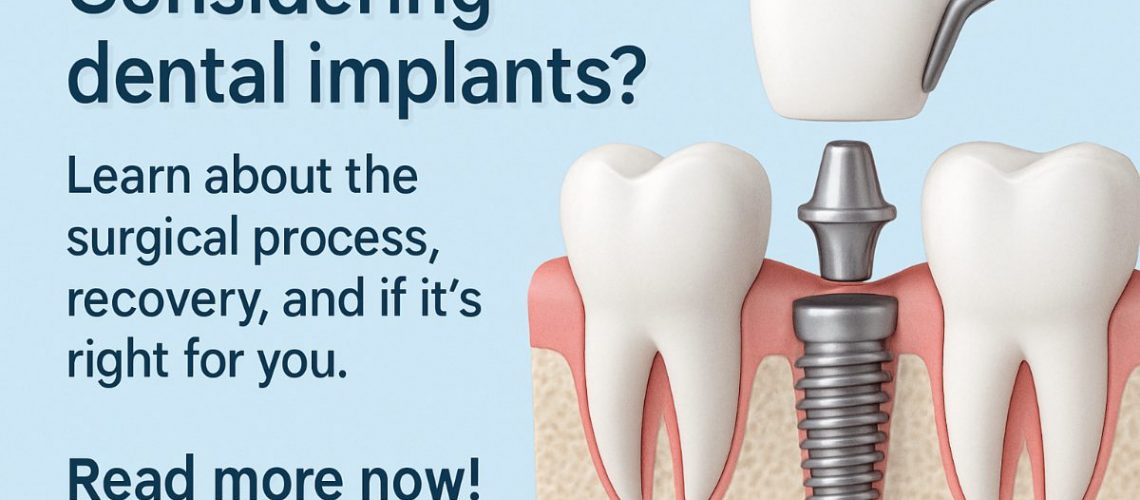
Endosteal implants—titanium or zirconia posts placed into the jawbone—are the most common option used for surgical placement. For patients with severe upper jaw bone loss where standard implants are not possible, zygomatic implants anchor into the cheekbone and provide an alternative path for support. Subperiosteal and mini implants are not part of this discussion.
The pre-surgical planning process
Comprehensive imaging and 3D planning
A cone-beam CT (CBCT) scan maps bone volume, nerve pathways, and sinus anatomy. Intraoral scanning captures your bite and soft-tissue contours. These 3D images help the surgeon plan where to place each implant safely, avoiding vital structures.
Digital navigation and surgical guides
Dynamic navigation systems, such as X-Guide®, provide real-time tracking during surgery to improve placement accuracy. Surgical guides created from digital plans can also precisely direct drilling. Using these technologies reduces risk and improves predictability when installing dental implants near Marion, IL.
Medical review and anesthesia choices
Your surgeon will review your medical history, medications, and any bleeding or healing issues. Office-based sedation options are available, with safe IV access aided by AccuVein® vein visualization. Note: there is no same‑day consult-to-surgery pathway; careful planning and medical review matter to ensure safety.
What happens during the implant surgery
On the day of surgery, you will receive local anesthesia and the chosen sedation. Any necessary tooth extractions are performed first; when appropriate, an implant may be placed into the extraction site. The surgeon uses precise osteotomy techniques—often with PIEZOSURGERY® ultrasonic instruments—to prepare the bone while protecting soft tissue. Navigation tools like X-Guide® help position the implant. The implant (endosteal or zygomatic when indicated) is then placed and measured for primary stability.
Techniques that improve healing and outcomes
Autologous Platelet-Rich Fibrin (PRF) is commonly used to promote faster soft-tissue healing and reduce discomfort. Osstell ISQ measurements assess initial implant stability and track osseointegration over time. For periodontal problems or failing implants, PerioLase® laser therapy can treat infected tissue and support tissue regeneration.
Recovery and aftercare when installing dental implants near Marion, IL
Expect mild to moderate swelling and discomfort for a few days, which can be managed with prescribed or over-the-counter pain medications. Soft foods and limited chewing at the surgical site are advised for 1–2 weeks. Avoid heavy exercise for several days. Follow-up visits check healing, remove sutures if needed, and monitor stability with Osstell ISQ readings. Contact your surgeon promptly if you have severe pain, fever, worsening swelling, persistent numbness, or signs of infection.
Success rates, risks, and how to reduce complications
When medical factors are controlled, and bone quality is good, dental implants have high success rates. Smoking, poor oral hygiene, and uncontrolled systemic disease raise the risk of failure. Common complications include infection, implant failure, and sinus or nerve issues. Using precise planning, navigation, PIEZOSURGERY®, PRF, and stability monitoring with Osstell reduces these risks.
Timeline and coordination with your general dentist
Typical steps: consultation and CBCT imaging, surgical planning, implant placement, healing and stability monitoring, then coordination with your general dentist for the final restorative phase. The surgical clinic focuses on safe placement and monitoring of implants; your trusted general dentist handles the final dental prosthesis and bite work. Communication between the surgical team and your dentist ensures a smooth handoff.
Costs and financing basics for installing dental implants near Marion, IL
Costs vary by the number of implants, the need for bone or sinus grafting, the use of advanced navigation or sedation, and the complexity (standard endosteal vs. zygomatic). Many patients use dental financing plans, medical financing, or staggered treatment to manage costs. Specific pricing depends on the individualized treatment plan and is reviewed during your consultation.
Why choose Oral & Maxillofacial Surgery of Carbondale for installing dental implants near Marion, IL
Oral & Maxillofacial Surgery of Carbondale is about 15 minutes from Marion and serves Jackson, Williamson, Johnson, Union, Franklin, Perry, and Randolph Counties. The team is led by board-certified surgeons with over 24 years of combined experience and places more than 600 dental implants annually. The office is an X‑Nav Center of Excellence and uses CBCT, intraoral scanning, X-Guide® navigation, PRF, PIEZOSURGERY®, PerioLase®, Osstell ISQ, and AccuVein® to plan and treat with surgical precision. The practice emphasizes careful planning (no same‑day consult-to-surgery) and full collaboration with your local dentist. Patients receive close, 24-hour communication when needed.
Other oral surgery services offered
The practice also performs wisdom tooth removal, surgical extractions, bone grafting, treatment of failing implants, orthognathic surgery, TMJ care, and oral pathology evaluation.
Next steps
To request an evaluation for dental implant placement near Marion, IL, call the office or schedule an appointment online. Bring your medical history, a list of medications, and any prior imaging if available. Careful planning, advanced technology, and experienced surgeons make implant surgery safer and more predictable.